
Ask the internet how to pick lottery numbers and you get wheeling systems, overdue-number trackers, and a man selling a spreadsheet. All of it rests on the same broken premise: that some combinations are likelier than others.
They are not. Not one of them. But that does not make every choice equal, and the difference is worth real money.
Can any strategy improve your odds of winning?
No, and the reason is arithmetic rather than opinion.
Powerball draws five balls from 69, then one from a separate pool of 26. That produces 292,201,338 distinct tickets. Each one has exactly one chance in 292,201,338 of matching. Your birthday. Your dog’s birthday. 1-2-3-4-5. Identical.
Buying more lines is the only thing that genuinely raises your chance of winning, and it raises it in proportion to what you spend, which is why it is not a strategy so much as a purchase. Ten lines gives you ten chances in 292 million. It also costs ten times as much.
What you can change: who you split with
Here is the part that survives scrutiny.
A lottery jackpot is not a fixed prize. It is a pot divided among everyone holding the winning line. Two winners means half each. Four means a quarter. And the number of people holding any given combination is wildly uneven, because human beings do not pick randomly.
Your odds of winning are fixed. Your expected winnings are not. Pick a combination that fewer people share and you keep more of the pot in the branch of reality where you win.
The most famous demonstration came on 30 March 2005, when Powerball paid out to 110 second-prize winners in a single draw instead of the four or five it expected. Investigators found the cause: the numbers had been printed in fortune cookies from a single Long Island bakery, and thousands of people played them. The machine was fine. The players were correlated.
How often does a jackpot actually get split?
More often than the fortune cookie story alone would suggest, and here the record is unambiguous.
Since October 2015 there have been 75 Powerball draws where somebody hit the jackpot. Sixty-nine went to a single ticket. Five were split two ways. One was split three ways.
That is 8% of jackpots shared, about one in twelve. Put the other way round: roughly one jackpot winner in twelve watches half or two-thirds of the largest sum of money they will ever see go to a stranger who picked the same five numbers.
Eight percent is not a rounding error on a nine-figure prize. On a $700 million annuity it is the difference between $700 million and $350 million, decided entirely by how ordinary your combination was.
The birthday problem
The single biggest distortion in how people pick is dates.
Birthdays, anniversaries, children’s ages. All of it lives between 1 and 31, and a great deal of it between 1 and 12. Powerball runs to 69. Mega Millions runs to 70. Everything above 31 is systematically under-played by a large margin.
That has a direct consequence. A five-number line drawn entirely from 1 to 31 is a line you are far more likely to be sharing. A line weighted toward 32 and above is a line fewer people hold.
It does not make the line likelier to come up. It makes it worth more if it does.
Patterns you pick without noticing
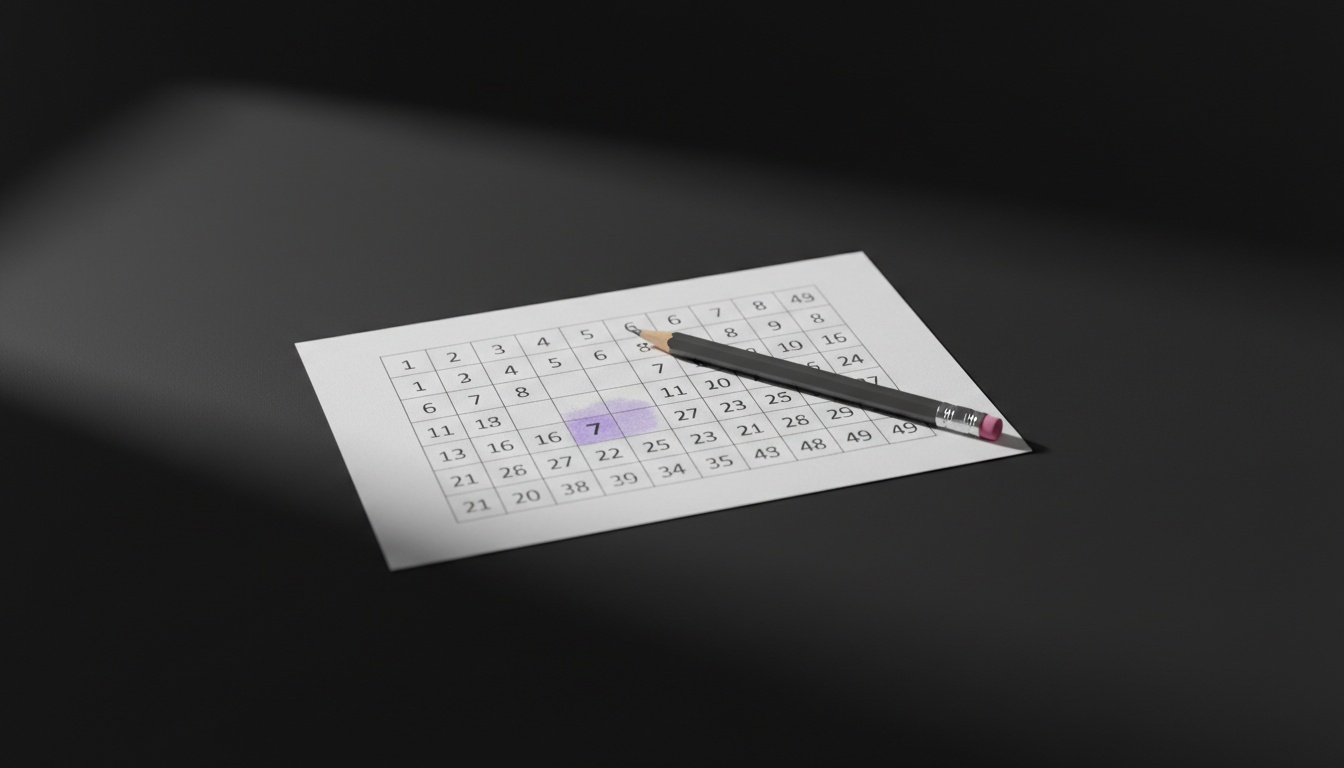
Play slips are grids, and people mark grids like people. Straight lines. Diagonals. Boxes. The four corners. Anything that looks tidy on paper is being marked by thousands of others at the same moment, for exactly the same reason.
Sequences are worse. An estimated ten thousand or more tickets carry 1-2-3-4-5 in a typical large draw, played mostly by people making the entirely correct point that it is as likely as anything else. They are right about the odds and wrong about the payout. Winning with it would be a catastrophe of arithmetic.
Multiples of five, all-even and all-odd lines, and numbers that make shapes are the same trap in different clothes.
Quick pick or choose your own?
Most jackpot winners used quick picks. This gets quoted constantly as evidence that quick picks are luckier, and it is a straightforward sampling error.
Roughly three-quarters of tickets sold are quick picks, so roughly three-quarters of winners hold them. If quick picks won at a rate different from their share of tickets sold, that would be a scandal worth investigating. They do not.
What quick picks do offer is genuine randomness, which sidesteps the crowding problem by accident. A machine has no birthdays and no fondness for diagonals. If you have no appetite for thinking about any of this, a quick pick is a perfectly sound default and better than most deliberate systems.
Choosing your own is fine too, as long as you choose like a machine rather than like a person.
What about hot, cold and overdue numbers?
They describe the past. They forecast nothing.
We counted all 1,388 Powerball draws since the current matrix began and ran a chi-square test on the result. It came back at p = 0.14, meaning the spread between the most and least drawn numbers is exactly what a fair machine produces. There is no bias to ride and none to bet against. The full working is in Powerball most common numbers.
One caveat cuts the other way, and it is a nice irony. Because published hot-number lists are widely read, playing the hot numbers may put you in a crowd. The statistics will not help you win. They might help you share.
A method that follows from the evidence
If you want a procedure rather than a lecture, this is the one the reasoning supports.
- Spread above 31. Let at least two or three of your five sit in the 32 to 69 range, where the crowd thins out.
- Break the shapes. Look at your marks on the slip. If they form a line, a block or a neat diagonal, move one.
- Skip the sequences. No runs, no all-multiples-of-five, no all-even and no all-odd.
- Do not chase frequency. Hot lists are published, and published means crowded.
- Or just take the quick pick. It does most of the above for free.
Every one of these adjusts your share of the pot, never your chance of reaching it. Any page telling you otherwise is selling something.
What no strategy can do
It cannot make you likely to win. One in 292 million stays one in 292 million after you have optimised everything on this page, and the expected value of a lottery ticket is negative at essentially every jackpot size once tax and sharing are counted.
Play the amount you are content to lose, because on any given night that is the overwhelmingly probable outcome. If it has stopped feeling like entertainment, the National Problem Gambling Helpline is on 1-800-522-4700, free and around the clock.
And if you are holding a ticket right now, the checker on our homepage will tell you what it did against the latest draw in about ten seconds.
Frequently asked questions
Is there a strategy to win the lottery?
No. No selection method improves your chance of winning, because every combination has exactly the same probability in every draw. Buying more lines raises your chance in proportion to what you spend, which is a purchase rather than a strategy.
What are the best numbers to pick for Powerball?
There are no best numbers for winning, since all 292,201,338 combinations are equally likely. The best numbers for keeping a jackpot are ones other players avoid: include several above 31, skip patterns and sequences, and ignore published hot-number lists.
Is quick pick better than choosing your own numbers?
Quick picks are not luckier. They account for most jackpot winners only because they account for roughly three-quarters of all tickets sold. They do avoid human biases such as birthdays and patterns, so they are a sound default if you do not want to think about crowding.
Does buying more tickets increase your odds of winning?
Yes, in direct proportion to the number of lines bought and the amount spent. Ten lines give ten chances in 292,201,338 rather than one. The expected value stays negative, so this increases your chance of winning without improving the value of the wager.
Should you avoid numbers 1 to 31?
Not entirely, but do not use only those numbers. The range 1 to 31 is heavily over-played because it covers calendar dates used for birthdays and anniversaries, so a line drawn entirely from it is more likely to be shared with other winners if it comes up.
How often is a lottery jackpot split between winners?
Of the 75 Powerball draws that produced a jackpot winner since October 2015, six were shared: five between two tickets and one between three. That is 8%, or roughly one jackpot in twelve. Mega Millions shared 2 of its 52 jackpot wins over a comparable period.
Should you play the same lottery numbers every week?
It makes no difference to your chance of winning, because each draw is independent of every other. Playing the same line does not make it more likely to come up, and switching does not make you miss out. Choose whichever you will find easier to keep track of.
Key takeaways
- No selection method changes your odds. Every combination is equally likely in every draw.
- Selection does change your expected payout, by changing how many people you split with.
- Numbers 1 to 31 are heavily over-played because of birthdays, so lines above 31 are shared less.
- Patterns, sequences and published hot numbers all attract crowds. The 2005 fortune cookie draw produced 110 second-prize winners at once.
- Quick picks are not luckier. They dominate the winner list because they dominate sales.
LottoScan is unofficial and not affiliated with any lottery operator. Nothing here is gambling advice, and no method described improves the probability of winning any prize.