

1. How Powerball Taxes Work: Why the 24% Withheld at Claim Isn't Your Final Tax Bill
The IRS withholds 24% of lottery winnings automatically at the point of claim. That money leaves before you see it. But 24% is not your final federal tax liability.
Lottery winnings are ordinary income. A jackpot of any meaningful size pushes the entire amount into the 37% federal income tax bracket, because that income sits on top of whatever else you earned that year.
The gap between the two rates is roughly 13 percentage points. That additional amount is owed at tax filing, not at claim.
The withholding is a deposit. Full stop. The IRS will collect the rest.
After claiming, the IRS expects quarterly estimated tax payments covering the additional federal liability. Miss those, and underpayment penalties accumulate on top of the tax itself. A winner who claims in January and does nothing until the following April is already behind. On a tax bill in the tens of millions, the dollar amount of those penalties is not trivial.
The cash option vs. annuity distinction matters here, because every tax calculation starts with which payout structure you choose. The advertised jackpot is the annuity value, the sum of 30 payments over 29 years. The cash option is a lump sum paid immediately, always less than the headline number, and it is what most winners actually take. All calculations below use the cash option unless stated otherwise.
The cash option is where the real math starts. It's also where most winners first realize the advertised number was never the real number.
---
2. How Much Would You Actually Keep After Taxes? Real Numbers on the $754M Jackpot
On the $327.5 million cash value from the 3 August 2026 draw, federal tax at 37% leaves approximately $206.3 million after federal taxes, before state tax takes another cut.
The calculation: 37% of $327.5 million is $121.2 million in federal tax. The 24% withheld at claim ($78.6 million) counts toward that bill, leaving roughly $42.6 million still owed at filing. State tax comes off the federal after-tax figure, and the range is wide. More on that in the next section.
The most recent draw in our database is 3 August 2026, with an advertised jackpot of $754,000,000 and a cash value of $327,500,000. There were no jackpot winners. These figures are unofficial. Verify the current jackpot and cash value with the official Powerball operator before acting on any number here.
The cash value reflects the present value of 30 annuity payments discounted at current interest rates, roughly 43% of the headline number, not the 50% many people assume. Powerball publishes both figures before each draw.
For draw-specific figures, use the official Powerball jackpot and cash value disclosure page or verify directly with the operator. The numbers shift with every jackpot.
How Much Is a $1 Billion Powerball After Taxes?
A $1.08 billion jackpot (November 2022) with a $558.3 million cash value nets $351.7 million in Florida (no state tax) or approximately $290.8 million in New York (10.9% state tax). Federal tax at 37% on the cash value was approximately $206.6 million. The $60.9 million difference between those two states is determined entirely by where the winner lived.
These are verified figures from that draw, not projections.
What Is the Payout on a $1.7 Billion Powerball After Taxes?
The $1.765 billion jackpot (October 2023, the second-largest in U.S. lottery history) with a $774.1 million cash value nets $487.7 million in Florida or Texas, and approximately $403.3 million in New York. Federal tax at 37% on the cash value was $286.4 million. New York's additional $84.4 million state tax on the cash value accounts for the difference.
Both examples are historical draws. The federal tax structure is the same on any future jackpot; only the cash value changes.
---
3. State Taxes on Powerball: How Your Residency Can Save You $35M or More
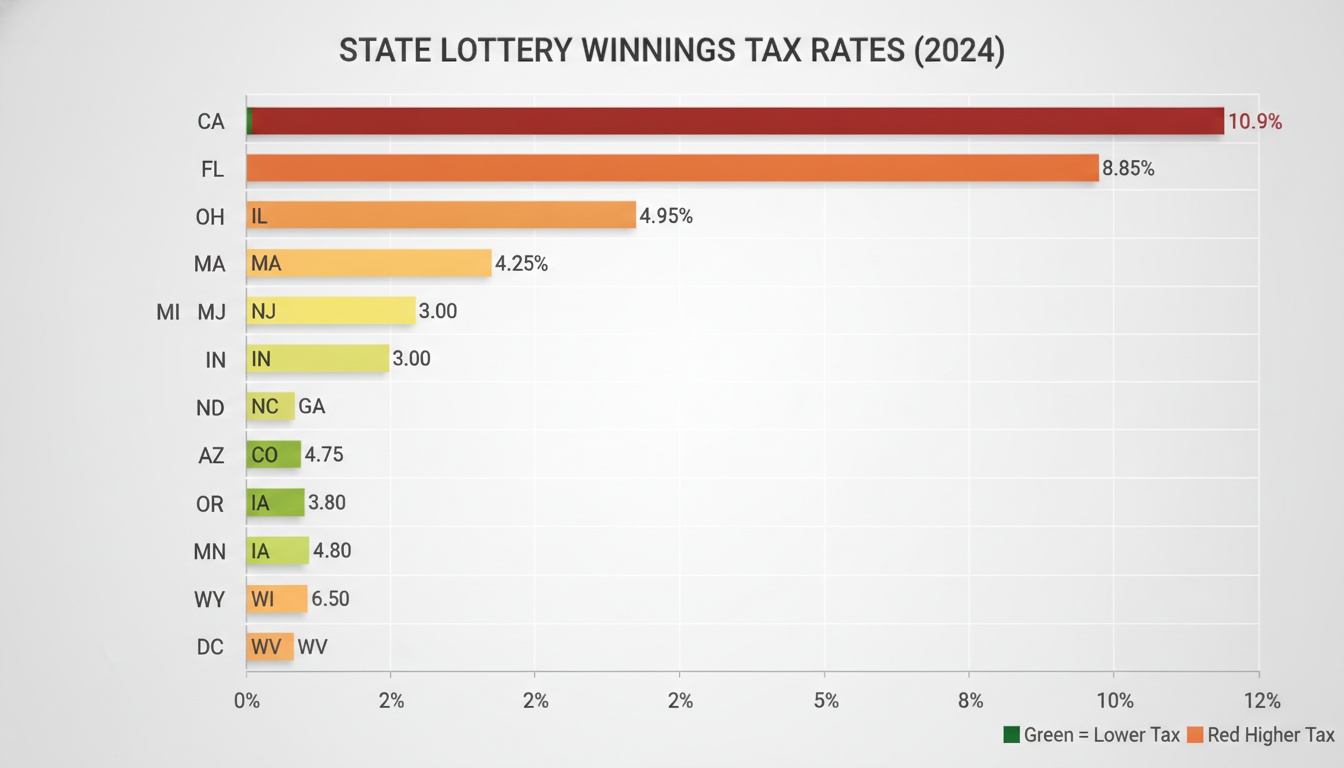
State income tax on lottery winnings ranges from zero to over 10%, and it sits on top of the federal bill. The state you live in matters more than most winners realize before they claim.
Nine states impose no state income tax at all, as of 2026 per Forbes: Alaska, Florida, Nevada, New Hampshire, South Dakota, Tennessee, Texas, Washington, and Wyoming. California and Delaware are a separate category: they have state income taxes but specifically exempt lottery winnings from them. For a winner taking the $327.5 million cash value on the 3 August 2026 draw, that exemption is worth tens of millions compared to a high-tax state.
New York sits at the other end. State income tax on lottery winnings there reaches 10.9%, as of 2026 per Forbes. Massachusetts runs 9%. These rates apply to the full cash value, not to what's left after federal tax, which is the part that catches people off guard.
Residency determines your state tax liability. Not where you bought the ticket. Where you live. This surprises more winners than it should.
Win in Florida but live in New York, and New York taxes your winnings as a resident. Some states, Arizona and Maryland among them, also tax non-residents who win within their borders, according to TaxAct. Two state tax bills on the same prize is exactly when a tax professional pays for themselves. The interaction between those two claims depends on each state's credit rules for taxes paid to other jurisdictions.
Here is the dollar impact of state tax on the $327.5 million cash value from the 3 August 2026 draw, after federal tax (37%) has already been deducted.
| State | State Tax Rate | Approximate Net After Federal and State |
|---|---|---|
| Florida / Texas / Wyoming (and other no-income-tax states) | 0% | ~$206,325,000 |
| California / Delaware | 0% (lottery exempt) | ~$206,325,000 |
| Massachusetts | 9% | ~$176,850,000 |
| New York | 10.9% | ~$170,627,000 |
Rates as reported by Forbes, current as of 2026. Tax law changes; verify current rates with a tax professional or the relevant state revenue authority before making any decisions.
The state you claim in is a decision worth making deliberately. The next section explains why the lump sum vs. annuity choice is equally consequential.
---
4. Lump Sum vs. Annuity: Which Maximizes Your After-Tax Winnings (And Why the Answer Isn't Obvious)
The annuity pays the full advertised jackpot across 30 payments over 29 years, with each payment taxed as ordinary income in the year it arrives. The lump sum delivers the cash value immediately, with the entire federal tax bill due in that single year.
The Tax Bracket Argument
The annuity's tax case is real. If federal tax rates fall in future years, later annuity payments benefit from those lower rates. If a winner's other income drops in retirement, some payments might land in a lower bracket.
The lump sum case is also real. A large sum invested immediately compounds over 29 years in a way that a series of smaller payments cannot match, assuming reasonable investment returns. Most winners choose the lump sum for investment control and certainty.
Investment Compounding and the Contrarian Case
Here is a simplified illustration using the $754 million jackpot from the 3 August 2026 draw. The annuity's first-year payment on a jackpot of this size would be approximately $11.4 million, based on Powerball's published payment schedule structure. Federal tax at 37% on that payment: approximately $4.2 million. Net first-year annuity payment after federal tax: approximately $7.2 million. By contrast, the lump sum of $327.5 million, taxed at 37% in a single year, leaves $206.3 million immediately available. Invested at a conservative 6% annual return over 29 years, that sum grows substantially. The annuity's total after-tax value depends on tax rates that don't yet exist.
The contrarian point worth making: the annuity is not the naive choice it's often presented as. For a winner without sophisticated investment infrastructure, the forced discipline of annual payments, each taxed as ordinary income rates as received, can produce a better real-world outcome than a lump sum that gets mismanaged in the first two years. The finance case for lump sum assumes the winner invests well. That assumption fails more often than the finance case admits.
For a more detailed comparison tailored to a specific jackpot amount, our Powerball payout and tax calculator runs the numbers on both options side by side. Already holding a ticket? Check your numbers against the latest draw, it takes 30 seconds and requires no account.
---
5. Tax Planning Strategies: What Actually Reduces Your Tax Bill (And What Doesn't)
Charitable Giving: The Most Effective Legitimate Tool
Qualified charitable tax deductions reduce taxable income in the year of the win, potentially saving $5-15 million in federal taxes on a nine-figure jackpot, depending on the contribution amount. This is the highest-impact planning lever available to most winners.
A donor-advised fund lets a winner claim a large tax deduction immediately, in the high-income year of the win, while distributing the funds to charities over the next 5-10 years. That gives you time to decide which causes matter most while locking in the tax benefit now. A charitable remainder trust can convert a portion of the jackpot into an income stream while removing that portion from the taxable estate. These are legitimate strategies with real dollar impact, not theoretical constructs.
Trusts and LLCs: Privacy, Not Tax Reduction
Claiming through a trust or LLC is the strategy most commonly misunderstood. I've seen this come up in nearly every discussion of lottery tax planning, and the answer is always the same: the trust doesn't shield you from income tax. It shields your name from the press release.
These entities are pass-throughs for tax purposes. The income flows to the beneficial owners and is taxed at their individual rates. This is a common misconception in lottery tax planning.
Timing and Estimated Payments
Timing of the claim creates a planning window in some states. A winner who discovers a ticket in November can claim in January, shifting the income into the following tax year. This does not defer federal tax on a lump sum indefinitely, but it does provide time to assemble a tax team and plan accordingly.
Estimated tax payments are not optional. The underpayment penalty isn't catastrophic in percentage terms, but on a tax bill in the tens of millions, the dollar amount is meaningful.
Downstream Tax Effects
Large lottery income phases out the Earned Income Tax Credit entirely. The EITC phases out above roughly $66,000 in income for most filers in 2026, so a jackpot winner loses it in the year of the win regardless of prior eligibility. The Child Tax Credit is similarly affected.
Jackpot income also triggers the 3.8% Medicare surtax on net investment income. The 2026 threshold is $200,000 for single filers and $250,000 for married filing jointly. A jackpot winner clears that threshold immediately, and any investment income in the same year is subject to the surtax as well. Account for this in estimated payment calculations. Verify current thresholds at IRS.gov.
International Winners
Non-US residents face different withholding rates and treaty implications. The standard IRS withholding rate for non-residents is 30%, not 24%, as of 2026. Tax treaties between the US and certain countries can reduce that rate, but the specific reduction depends on the treaty. Non-resident winners must complete IRS Form W-8BEN before claiming. This is genuinely a situation requiring specialist advice, not a general article.
---
6. Frequently Asked Questions About Powerball After Taxes
Do I owe taxes if I don't win the jackpot?
Yes. All Powerball prize money is taxable income. The IRS requires withholding on prizes above $5,000. Smaller prizes below that threshold are still reportable income even without automatic withholding. A $100 prize and a $100 million prize are both ordinary income for tax purposes; only the withholding mechanics differ.
Can I give my winnings to family members to avoid taxes?
No. The jackpot is taxed as income to the winner at the point of receipt. Gifts made afterward are subject to gift tax rules, with an annual exclusion per recipient. Amounts above that exclusion count against the lifetime gift and estate tax exemption. Giving money away after claiming does not reduce the income tax owed on the original prize.
Does winning Powerball affect my Social Security or Medicare?
Lottery winnings don't count as earned income for Social Security benefit calculations, according to TaxAct. They do count as income for purposes of the Medicare surtax, which applies above $200,000 for single filers and $250,000 for married filing jointly in 2026. A jackpot winner will almost certainly trigger that surtax in the year of the win. Verify current thresholds at IRS.gov.
What records should I keep after winning?
Keep the original ticket, all claim documentation, the W-2G form issued by the lottery, and any correspondence with the lottery operator. If you make charitable contributions in the same year, retain acknowledgment letters from each organization. Estimated tax payment confirmations should also be filed. These records support your tax return and any future audit.
Is the Powerball cash option always exactly half the advertised jackpot?
No. The cash value is the present value of the annuity payment stream, calculated using current interest rates at the time of the draw. When interest rates are high, the cash value is a smaller fraction of the advertised jackpot. The 3 August 2026 draw shows a $327.5 million cash value against a $754 million advertised jackpot: roughly 43% of the headline number, not 50%. Powerball publishes the cash value before each draw.
Can a trust or LLC reduce the taxes I owe on a Powerball jackpot?
Claiming through a trust or LLC provides privacy and can simplify estate planning, but it does not reduce federal income tax on the winnings. These entities are pass-throughs for tax purposes, meaning the income flows to the beneficial owners and is taxed at their individual rates. The only strategies that genuinely reduce taxable income in the year of the win are qualified charitable tax deductions, such as contributions to a donor-advised fund.
Are smaller Powerball prizes also taxable?
Yes. All Powerball prize money is taxable income regardless of size. The IRS requires withholding on prizes above $5,000. Prizes below that threshold are still reportable income on your federal return even without automatic withholding at the point of claim.
Do I pay state tax if I win Powerball in a different state from where I live?
Residency determines your primary state tax liability, not where you purchased the ticket. If you live in New York and win in Florida, New York taxes your winnings as a resident. Some states, including Arizona and Maryland, also tax non-residents who win within their borders, according to TaxAct, which can result in two state tax bills on the same prize, partially offset by credits depending on each state's rules.
---
7. Key Takeaways
Federal Tax
- The 24% withheld at claim is a deposit. The actual federal income tax rate is 37%, leaving roughly 13 percentage points owed at filing.
- On the 3 August 2026 draw ($327.5 million cash value), federal tax at 37% comes to approximately $121.2 million, leaving around $206.3 million in after-tax winnings before state tax.
- The EITC phases out entirely above roughly $66,000 in income in 2026. A jackpot winner loses it in the year of the win.
State Tax
- State tax ranges from 0% (Florida, Texas, and others) to 10.9% (New York), as of 2026 per Forbes. Residency determines liability, not where the ticket was purchased.
- The difference between a no-tax state and New York on the $327.5 million cash value is approximately $35.7 million.
Planning Strategies
- The annuity spreads tax exposure across 29 years; the lump sum concentrates the entire federal bill in one year. Most winners take the lump sum.
- Entity structures provide privacy and estate planning benefits. They do not reduce federal income tax on lottery winnings.
- Charitable giving strategies are the most effective legitimate tool for reducing taxable income in the year of the win.
- All figures here are from the LottoScan draw database and published sources. Verify with the official Powerball operator and a qualified tax professional before making any decisions.
---
Already holding a ticket? Check your numbers against the latest draw to see which prize tier you hit and what that tier paid. Free, no account required, 30 seconds.
---
This article is educational only and does not constitute tax or legal advice. Lottery tax situations are complex, state-specific, and change with legislation. Consult a qualified tax professional or CPA before claiming any prize.
If you or someone you know has a gambling problem, contact the National Problem Gambling Helpline at 1-800-522-4700.
---
IRS Publication 525 on taxable and nontaxable income Official Powerball jackpot and cash value disclosure page IRS Form W-2G instructions for reporting certain gambling winnings Forbes detailed breakdown of state lottery tax rates