

1. Powerball Prize Chart: All 9 Ways to Win
Pick 5 numbers from 1 to 69 (white balls), then pick 1 Powerball from 1 to 26 (the red ball). Match enough of them in the right combination and you win a prize. There are exactly 9 ways to do that.
| Match Combination | Prize | Odds (1 in) | Power Play Eligible |
|---|---|---|---|
| 5 white + Powerball | Jackpot (pari-mutuel) | 292,201,338 | No |
| 5 white, no Powerball | $1,000,000 | 11,688,053.52 | Yes (fixed at $2M) |
| 4 white + Powerball | $50,000 | 913,129.18 | Yes |
| 4 white, no Powerball | $100 | 36,525.17 | Yes |
| 3 white + Powerball | $100 | 14,494.11 | Yes |
| 3 white, no Powerball | $7 | 579.76 | Yes |
| 2 white + Powerball | $7 | 701.33 | Yes |
| 1 white + Powerball | $4 | 91.98 | Yes |
| Powerball only | $4 | 38.32 | Yes |
Minimum winning combination: Match only the red Powerball → $4. Matching 1 or 2 white balls alone wins nothing.
Overall odds of winning any prize: 1 in 24.87. Verify all prize amounts and odds at the official Powerball prize chart before acting on them.
Matching 1 white ball alone wins nothing. Matching 2 white balls alone wins nothing. The minimum winning combination is the red Powerball by itself, which pays $4. Matching 1 white ball plus the Powerball also pays $4. Neither of those outcomes is multiplied by Power Play (more on that below).
Odds of Winning Each Tier
The jackpot odds of 1 in 292 million are fixed combinatorial math, not a draw-frequency estimate. They don't change based on how long since the last jackpot hit. The overall odds of winning any prize, 1 in 24.87, include all 9 tiers combined.
To put the jackpot odds in context: you're roughly 200 times more likely to win $1,000,000 (Match 5, no Powerball) than to win the jackpot. That's still 1 in 11.7 million.
Why the Advertised Jackpot Is 50% Higher Than What You'd Actually Receive
The jackpot is pari-mutuel, nobody knows the exact final figure until the draw closes and ticket sales are tallied. It starts at a minimum guaranteed amount and grows with ticket sales from draw to draw until someone wins it. The number Powerball advertises is the annuity value: the total of 30 payments made over 29 years. The cash value is always lower, because it represents the present-day lump sum that, when invested in U.S. Treasury securities, would fund those 30 payments.
Using a hypothetical advertised jackpot of $794,000,000 as an example: the cash value would be approximately $345,200,000. That's a roughly 56% reduction before a single dollar of tax is applied. The ratio varies draw to draw depending on current interest rates, but the lump sum is typically 45 to 55 percent of the advertised figure.
That ratio hasn't always been this low. In 2020 and 2021, when Treasury yields were near zero, the cash value was often 65 to 70 percent of the advertised jackpot, the discount was smaller because the cost of funding 30 future payments was lower. As rates rose through 2022 and 2024, the ratio compressed. At current rates, winners should expect the cash value to be in the range of 45 to 55 percent of the advertised figure, not the 60 percent-plus that older guides still quote — though this can fluctuate with interest rate conditions.
In contrast, all prizes below the jackpot (tiers 2 through 9) are fixed cash amounts. They don't grow with ticket sales. One exception: in California, all prizes including lower tiers are pari-mutuel by state law, so California winners may receive different amounts than the fixed figures above.
---
2. Lump Sum vs. Annuity: Which Option Leaves You With More Money After Taxes?
The annuity pays more in total nominal dollars. That is not debatable. The question is whether those future dollars are worth more to you than a smaller amount available today.
How the Annuity Works
The annuity option delivers 30 payments over 29 years. The first payment arrives when you claim the prize. Each subsequent payment is 5% larger than the one before it. Every payment is backed by U.S. Treasury securities purchased by the lottery at the time you claim, meaning you don't need investment skill, a financial advisor, or favorable market conditions to receive the full payout. For a winner with no investment experience, that's not a consolation prize. It's a genuine structural advantage that gets underplayed.
How the Lump Sum Works
The lump sum is a single immediate payment equal to the cash value at the time of the draw. Using a hypothetical $794,000,000 advertised jackpot as a concrete example: the annuity would pay out $794,000,000 in total over 29 years. The lump sum would be approximately $345,200,000 before taxes.
Which Option Leaves You With More Money After Taxes?
To come out ahead with the lump sum, a winner needs to consistently earn after-tax investment returns that exceed the implied discount rate embedded in the annuity structure over three decades. That's achievable but not guaranteed, and the behavioral risk is real. I've read enough lottery case studies to know that "I'll invest the rest" is the most expensive sentence in the English language.
Which Payment Option Do Most Winners Choose?
Approximately 80 percent or more of jackpot winners take the lump sum. Lottery attorneys treat it as the default assumption in their planning conversations. The reasons are practical: federal and state taxes apply regardless of payment option, the lump sum eliminates 29 years of counterparty risk, and most winners want immediate control over the money.
That said, the annuity has a genuine structural advantage that gets underplayed. For a winner with no investment experience, no trusted fiduciary, and a realistic view of their own spending habits, the annuity isn't a bad answer.
Only the jackpot offers the annuity option. All other prize tiers pay as a single cash amount.
Per the official Powerball game rules (available at powerball.com), jackpot winners typically have 60 days after the ticket is validated to elect their payment option. This window varies by state and several states impose shorter deadlines. Confirm your state's specific deadline before signing anything.
How Powerball Compares to Mega Millions
By contrast, Mega Millions uses the same annuity and cash structure with 30 payments over 29 years, but the odds of winning the jackpot are 1 in 302.5 million, slightly worse than Powerball's 1 in 292.2 million. The prize tiers and tax treatment are nearly identical. If you're choosing between the two games, the odds difference is marginal; the jackpot size on any given week is the more practical factor.
---
3. Powerball Payout After Taxes: What You Actually Keep
The advertised jackpot is not your money. The cash value is not your money. What's left after federal and state taxes is closer to your money, and even that figure is an estimate until you file.
Federal tax: The IRS withholds 24% automatically on prizes over $5,000 at the time of payment, under current IRS rules as of 2026. For jackpot winners, that withholding is just the down payment. The actual federal tax liability climbs to 37% (the top marginal rate as of 2026) on income at jackpot scale. The gap between 24% withheld and 37% owed comes due at filing. Plan for it.
State tax: This is where the variation is sharp.
| State | State Lottery Tax Rate | Notes |
|---|---|---|
| Florida | 0% | No state income tax; lottery winnings not subject to state tax |
| Texas | 0% | No state income tax; lottery winnings not subject to state tax |
| Wyoming | 0% | No state income tax; lottery winnings not subject to state tax |
| California | 0% | Lottery winnings exempt from state income tax |
| Pennsylvania | ~3.07% | Flat rate, verify current rate |
| Michigan | ~4.25% | Flat rate, verify current rate |
| Illinois | ~4.95% | Flat rate, verify current rate |
| Arizona | ~2.5% | Verify current rate |
| Massachusetts | ~5% | Verify current rate |
| New York | Up to 10.9% | NYC residents add up to 3.876% |
These are ranges based on published rates. Tax law changes. Verify current rates with a tax professional or your state revenue department before making any decisions. For a full breakdown by state, see our state lottery tax guide.
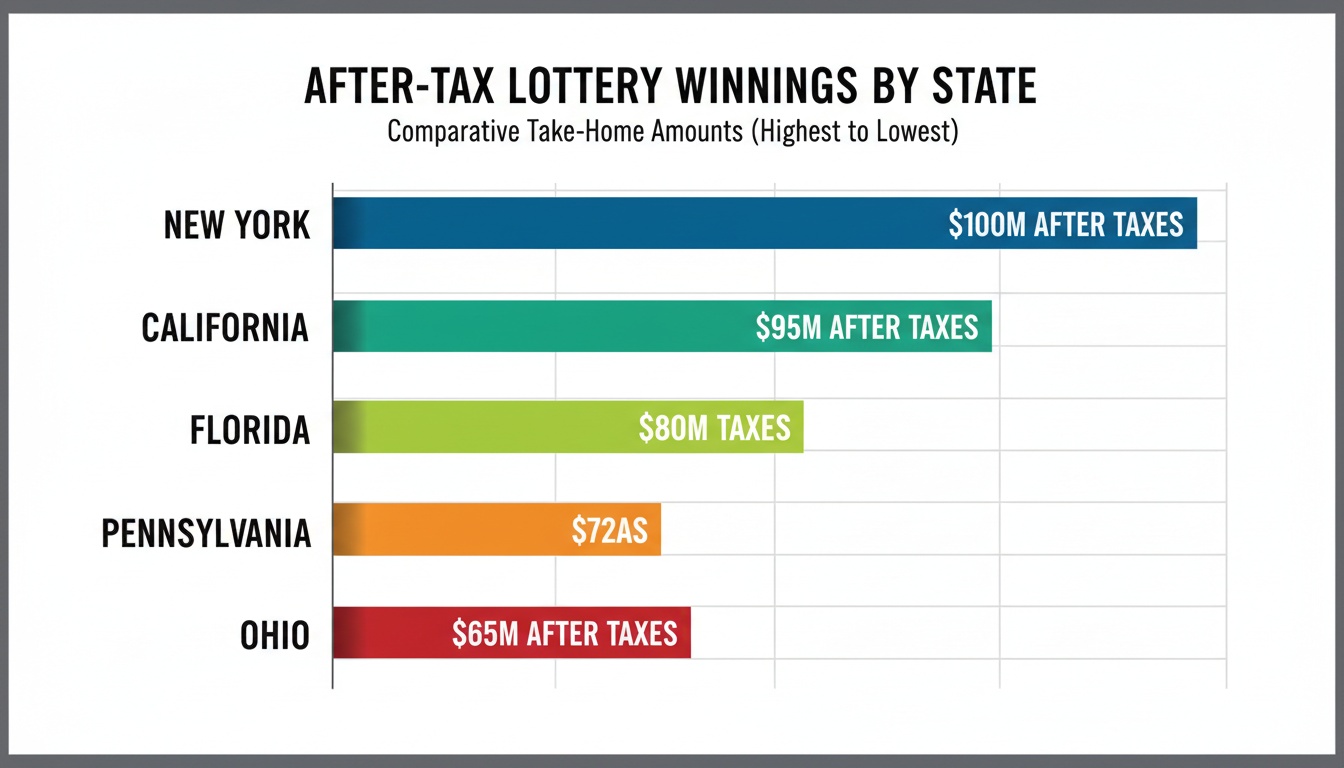
Working through a hypothetical $345,200,000 cash value example step by step:
Cash value: $345,200,000
- Federal withholding (24%): $82,848,000 taken at payment → ~$262,352,000 remaining
- Remaining federal liability (13% gap to 37%): ~$44,876,000 owed at filing → ~$217,476,000 remaining
- New York State (10.9%): ~$37,605,000 → ~$179,871,000 remaining
- NYC city tax (3.876%): ~$13,374,000 → ~$166,497,000 final estimate
- Florida resident stops at Step 2: ~$217,476,000
These are estimates. Your actual liability depends on deductions, filing status, and the tax year. Plug your state and jackpot amount into our Powerball tax calculator to see your exact after-tax take-home, on a $345M cash value, the difference between Florida and New York City is over $50 million, so this is worth two minutes of your time.
Non-U.S. residents face a higher federal withholding rate under IRS rules. Verify this with a tax attorney who handles international lottery claims before proceeding.
Prizes below $600 are generally not reported to the IRS under current rules (confirm thresholds with IRS Publication 525, gambling winnings section). Prizes between $600 and $5,000 are reported but not automatically withheld. You still owe tax on them; the withholding just doesn't happen at the lottery window.
How to Claim Your Prize (By Tier)
$4 prizes (tiers 8 and 9): Most retailers pay these on the spot. Present your Powerball ticket and collect.
Up to $599: Retailer or any lottery terminal in your state.
$600 to $99,999: Typically requires a visit to a lottery claim center with your signed ticket and valid photo ID.
$100,000 and above: Usually requires a claim at lottery headquarters. Do not sign the ticket until you've spoken with an attorney.
Jackpot: Headquarters claim only. Get legal and financial counsel before you sign anything, before you tell anyone, and before you do anything else. The claim deadline varies by state, typically ranging from 90 days to one year from the draw date. Confirm your state's exact deadline with your state lottery before doing anything else. Missing it forfeits the prize permanently.
One option many winners overlook: in several states, you can claim anonymously through a trust or LLC rather than in your own name. This is legal where permitted and has significant privacy and estate planning implications. Ask a lottery attorney whether your state allows it before you claim. Our lottery prize claim guide covers the documentation requirements by prize tier.
Before heading to the lottery office, verify your ticket against the official draw results, it takes under a minute and eliminates the risk of misreading your numbers.
---
4. Should You Buy Power Play? What It Costs and What It Actually Wins You
Power Play is a $1 add-on that multiplies non-jackpot prizes by 2x, 3x, 4x, 5x, or 10x depending on the multiplier drawn before the main drawing. The 10x multiplier is only available when the advertised jackpot is $150 million or less. The jackpot is never multiplied.
A standard Powerball ticket costs $2. With Power Play, it's $3. The multiplier is drawn from a separate ball pool before the main drawing.
| Base Prize | 2x | 3x | 4x | 5x | 10x |
|---|---|---|---|---|---|
| $50,000 (Match 4 + PB) | $100,000 | $150,000 | $200,000 | $250,000 | $500,000 |
| $100 (Match 4) | $200 | $300 | $400 | $500 | $1,000 |
| $100 (Match 3 + PB) | $200 | $300 | $400 | $500 | $1,000 |
| $7 (Match 3) | $14 | $21 | $28 | $35 | $70 |
| $7 (Match 2 + PB) | $14 | $21 | $28 | $35 | $70 |
| $4 (Match 1 + PB) | $8 | $12 | $16 | $20 | $40 |
| $4 (Powerball only) | $8 | $12 | $16 | $20 | $40 |
Power Play doesn't multiply the jackpot. Ever. That's the single most common misconception I see in lottery forums and comment sections, and it's worth saying twice.
One common misconception about the second tier: the Match 5 (no Powerball) prize does not scale with the multiplier drawn. It's fixed at $2,000,000 with Power Play, regardless of whether a 2x or 10x ball comes out. The structural reason is that a 10x multiplier on a $1,000,000 prize would create unacceptable prize pool exposure for the operator, so they capped it at a flat $2,000,000. It's a reasonable business decision, but a confusing one for players who assume the multiplier applies uniformly across all tiers.
Is Power Play Worth $1 Extra? The Honest Answer
Power Play costs $1 extra but does not change your chances of winning anything. What it does is make your prize larger in the scenarios where you win something, which is a different thing. If you're playing for the jackpot, Power Play is irrelevant to that outcome. If you want the chance at a $2 million second-tier prize instead of $1 million, it's the right tool. But don't buy it expecting better chances.
---
5. Double Play Payout Chart: A Second Drawing for $10 Million
Double Play is a separate $1 add-on that enters your same 5+1 numbers into a second drawing with a fixed $10,000,000 top prize, regardless of the main jackpot size. All Double Play prizes are fixed cash amounts with no annuity option.
A Powerball ticket with both Power Play and Double Play costs $4 total. The Double Play drawing takes place after the main Powerball drawing. That asymmetry between the $10M fixed top prize and a potentially $800M main jackpot is worth noting if you're comparing the two drawings.
| Match Combination | Double Play Prize |
|---|---|
| 5 white + Powerball | $10,000,000 (fixed) |
| 5 white, no Powerball | $500,000 |
| 4 white + Powerball | $50,000 |
| 4 white, no Powerball | $500 |
| 3 white + Powerball | $500 |
| 3 white, no Powerball | $20 |
| 2 white + Powerball | $20 |
| 1 white + Powerball | $10 |
| Powerball only | $10 |
Double Play is not available in all states. Check with your state lottery before assuming it's an option at your retailer. See our Double Play availability guide for current state coverage, or check official Double Play availability at powerball.com.
---
6. Frequently Asked Questions About Powerball Payouts
What are the payouts on Powerball?
Powerball offers 9 prize tiers. Fixed prizes run from $4 (matching only the red Powerball) up to $1,000,000 for matching all 5 white balls without the Powerball. The jackpot is pari-mutuel and varies by draw. Verify the current jackpot and cash value at powerball.com.
Not sure which tier your ticket hit? Check your numbers here against the latest draw.
What's the pay chart for Powerball?
The full 9-tier prize chart is in the first section of this article. The key structural distinction: tiers 2 through 9 are fixed cash amounts paid immediately, while the jackpot (tier 1) is pari-mutuel and offers either a lump sum or 30-payment annuity. In California, all prizes including lower tiers are pari-mutuel by state law.
How many numbers do you need to win a prize with Powerball?
Matching only the red Powerball (1 number) wins $4, the minimum prize. Matching white balls alone requires at least 3 to win anything: 3 white balls with no Powerball pays $7. Matching 1 or 2 white balls without the Powerball wins nothing.
What is 1 number and Powerball worth?
Matching the red Powerball alone wins $4, the minimum prize in Powerball. Matching 1 white ball plus the Powerball also wins $4. Neither outcome qualifies for Power Play multiplication, these are the two lowest-tier prizes in the game, and both pay the same amount regardless of the multiplier drawn.
Common Mistakes Winners Make When Choosing Payout Options
- Signing the ticket before consulting an attorney. Once you sign, the ticket is legally yours in your name, with estate, tax, and privacy implications that can't be undone. The stories that stick with me are the ones where someone signed the ticket in the parking lot of the gas station, posted a photo on social media, and called their boss before they'd spoken to anyone with a law degree. Every one of those decisions is reversible in isolation. Together, they're not.
- Choosing lump sum vs. annuity without modeling your specific state tax situation. A Wyoming winner and a New York City winner looking at the same $345,200,000 cash value face dramatically different after-tax outcomes. Run the numbers for your state before deciding.
- Assuming the 24% withheld at payment equals your final tax bill. It doesn't. The effective federal rate for jackpot winners is 37%. The gap is owed at filing. Three other patterns come up repeatedly: missing state claim deadlines, failing to account for how a large windfall affects other income and deductions, and overlooking estate planning implications. Use a Powerball tax calculator as a starting point, then get a tax attorney.
See IRS Publication 525, gambling winnings section for current thresholds and withholding rules. Verify all prize figures at the official Powerball prize chart.
---
7. The Short Version
Prize Structure
- Powerball has 9 prize tiers. The minimum winning combination is the red Powerball alone, worth $4.
- The jackpot is pari-mutuel. All other prizes are fixed cash amounts (except in California).
- The cash value is typically 45 to 55 percent of the advertised annuity figure, though this can fluctuate with interest rate conditions — not the 60 percent-plus that older guides quote.
Tax Implications
- Federal withholding at payment is 24% for prizes over $5,000 under current IRS rules. The actual federal liability for jackpot winners is 37%. The gap is owed at filing.
- State tax ranges from 0% (Florida, Texas, Wyoming — no state income tax) to over 10% (New York, including city tax for NYC residents). California exempts lottery winnings from state income tax.
Add-Ons and Claiming
- Power Play multiplies non-jackpot prizes by 2x to 10x for $1 extra. The Match 5 (no Powerball) prize is fixed at $2,000,000 with Power Play regardless of the multiplier drawn. The jackpot is never multiplied.
- Double Play is a separate $1 add-on with a fixed $10,000,000 top prize. Not available in all states.
- In several states, you can claim through a trust or LLC to preserve anonymity. Ask a lottery attorney before you claim.
- Sign nothing and tell no one until you've spoken with a lottery attorney.
Matched some numbers and want to confirm your prize tier? Check your ticket here.
Frequently asked questions
What are the payouts for Powerball?
Powerball has nine prize tiers. Matching all five white balls plus the Powerball wins the jackpot. Five whites alone pays $1,000,000. Four plus the Powerball pays $50,000, four whites alone $100, three plus the Powerball $100, three whites $7, two plus the Powerball $7, one plus the Powerball $4, and the Powerball on its own $4. Every figure below the jackpot is fixed rather than pari-mutuel in most states.
What does 2 numbers on Powerball pay?
Two white balls alone pay nothing. Two white balls plus the Powerball pay $7, and that is the tier people usually mean. The Powerball itself is what turns a losing line into a winning one at the bottom of the table, which is why one number plus the Powerball still pays $4 while three white balls without it pay $7.
What does one number plus the Powerball pay?
One white ball plus the Powerball pays $4, the same as matching the Powerball on its own with no white balls at all. Both are the minimum prize, and both return double the $2 ticket price.
What do 4 numbers and the Powerball pay?
Four white balls plus the Powerball pay $50,000 before tax. Four white balls without it pay $100. With Power Play the $50,000 tier multiplies by the drawn multiplier, up to five times, so the same line can pay $250,000.
Does the Powerball payout chart change by state?
The prize amounts are the same in every participating state, because Powerball is a single national game with one prize table. What differs by state is tax: some states withhold nothing on lottery winnings and others take up to 10.9%, and a few impose tax without withholding it at payout. Use the lottery tax calculator for a state-by-state figure.
How much does Power Play add?
Power Play costs $1 more per line and multiplies every non-jackpot prize by the multiplier drawn that night, which is 2, 3, 4, 5 or 10. The 10x multiplier only appears when the advertised jackpot is below $150 million. The $1,000,000 tier for five white balls is capped at $2,000,000 regardless of the multiplier drawn.
Are these amounts what you actually receive?
No. Every figure here is the advertised prize before tax. Federal withholding takes 24% on prizes over $5,000 while the top federal rate is 37%, so a large balance is still owed at filing, and state tax may apply on top. The jackpot figure is the annuity value; the lump sum is materially lower.